
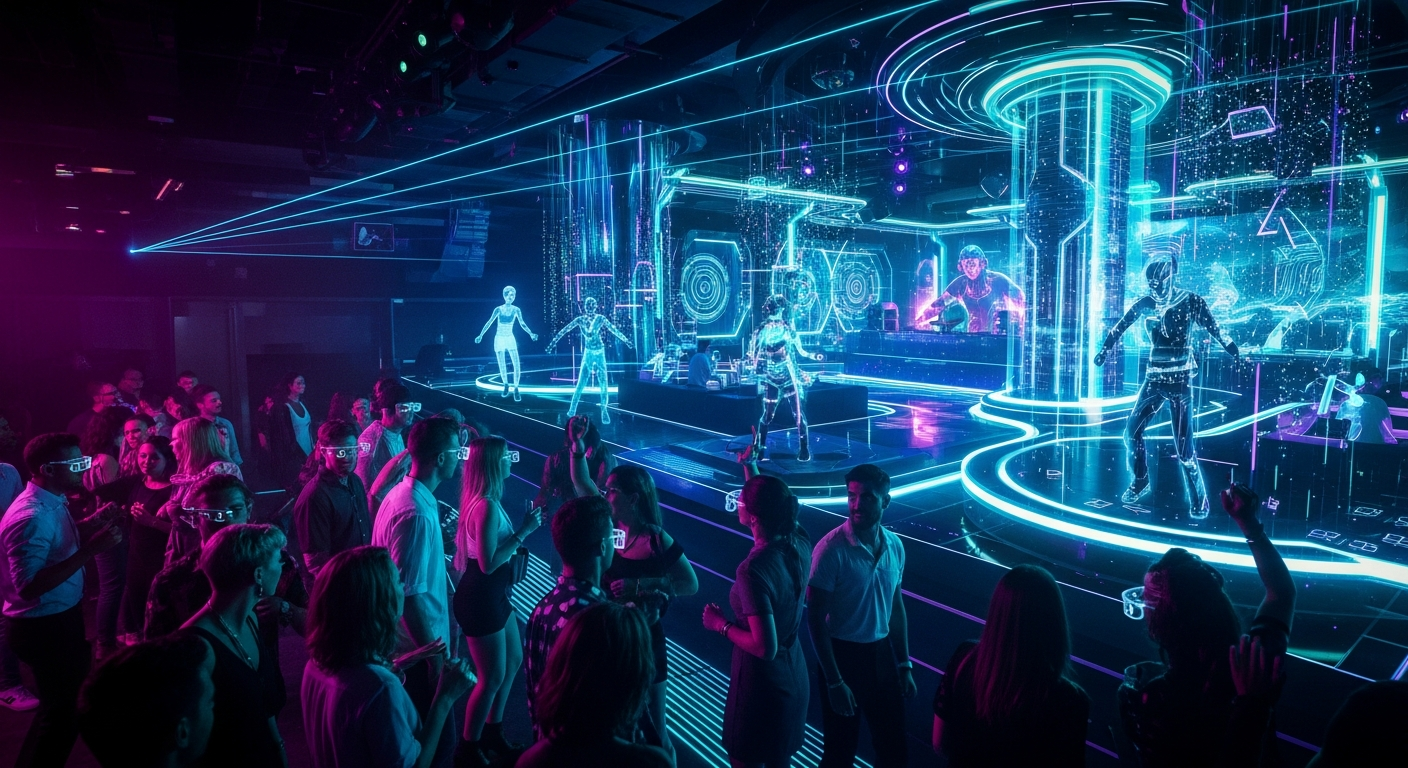
The night will never follow the same rules again. While physical dancefloors continue to vibrate to the beat of music, another dimension of clubbing is being born: metaverse & hybrid nightlife is transforming how we dance, socialize, and experience the party. This new dimension isn’t an alternative disconnected from reality but a radical evolution where the physical and virtual dance together to the same rhythm. The result is the frontier of partying: phygital clubbing, where the boundaries between the real world and the digital one dissolve completely.
The Phenomenon of “Metaverse Clubs”: From Amnesia Ibiza to VRChat
When the legendary Amnesia nightclub in Ibiza opened a virtual replica on Decentraland in 2021, it did more than create a secondary experience: it proved that clubbing could be entirely redefined. Today, this hybridization has become the new standard in the nightlife industry.
The Decentraland platform hosts a virtual space for Amnesia where users can dance with personalized avatars, listen to live DJs, and participate in global events. The beauty of this approach? It doesn’t require an expensive flight to Ibiza. A student in Tokyo, a professional in Berlin, and a family in Toronto can find themselves in the same virtual space, celebrating the same night together.
But Decentraland isn’t the only player in this new ecosystem. VRChat, a free platform available on Steam, has developed a vibrant community of virtual clubs where DJs perform live sets in front of global crowds. Recently, this platform has attracted thousands of clubbers who desire a niche, accessible experience that’s less socially demanding than traditional clubs. Legitimate DJs play with real MIDI controllers, creating a sense of authenticity that surprises those discovering this parallel reality for the first time.
Vision Dubai: The Hybrid Physical-Virtual Model
Vision Dubai exemplifies the ultimate model of phygital evolution. Launched in 2022 at The H Hotel in Dubai, Vision Dubai is a distinctive mixture of virtual and physical experiences, offering both simultaneously. Guests entering the physical club encounter an experience enriched by NFTs, cryptocurrency, and real-time access to the metaverse. Notably, the 2025 edition of Vision Dubai tool place on November 17–18, 2025, at Dubai WTC.
Inside Vision, visitors can convert digital currency into cocktails, purchase exclusive NFTs that unlock VIP zones in both physical and virtual spaces, and connect in real-time with users from the remote metaverse. The club has even collaborated with the renowned luxury brand Jacob&Co to launch exclusive NFT watches, creating a tangible bridge between digital value and physical assets.
What makes Vision revolutionary isn’t just the technology but the underlying logic: the 2026 clubber doesn’t have to choose between physical and virtual. They can experience both simultaneously, creating layers of experience that amplify each other.
Anyma and Immersive Technology: From the Las Vegas Sphere to European Experiences
If Vision represents accessible hybridization, the Las Vegas Sphere represents the pinnacle of technological obsession with total immersion. In December 2024, Anyma—the solo project of Matteo Milleri, half of Tale Of Us—brought electronic music inside this architectural colossus of 16K resolution and 111 meters in height.
“The End of Genesys” wasn’t a concert: it was a total multisensory experience. Spectators, seated in armchairs equipped with haptic devices, not only saw virtual reality integrate with Anyma’s music, but they also felt it. Every bassline vibrated through the body, augmented reality animations created a visual narrative that unfolded in four acts, and appearances by artists like Grimes and FKA Twigs transformed it all into a cultural event of worldwide significance.
The Sphere represents the immediate future: when immersive technologies reach such sophistication that they eliminate awareness of the boundary between real and virtual. For the European clubber, this means that major festivals will be able to replicate experiences of this caliber on smaller scales, creating moments of emotional telepresence where feeling the music becomes physically indistinguishable from attending the live event.
The Boom of DJ Sets in VR: Carl Cox on UNVRS
Carl Cox, a global clubbing legend, began his summer residency in Ibiza in June 2025 at UNVRS, a club that operates both physically and digitally. For the first time in clubbing history, VR fans wearing a Meta Quest headset can “stand” next to physical fans in the same space, creating a unified community across the virtual-physical boundary.
Cox also recorded a 7-hour set entirely in spatial audio for Apple Music, capturing the feeling of being on the dancefloor of UNVRS through immersive audio technology. This is a real way to experience world-class clubbing for those who can’t go to Ibiza.
This phenomenon represents a profound cultural shift: world-class artists no longer see VR apparatus as a distraction from the “real” experience but as a legitimate extension of their audience. DJs are optimizing their sets to be experienced simultaneously by physical people and virtual avatars, creating a new performance format that rewards both intimacy and scale.
Global Accessibility: Dancing in Ibiza from Japan Without Jet Lag
One of the most revolutionary advantages of hybrid virtual clubbing is the elimination of geographic and temporal barriers. A rigid time zone and the cost of a transcontinental flight have historically excluded clubbers from regions far from the major nightlife epicenters of Europe and North America.
Now, thanks to simultaneous metaverse clubs, a person in Japan can dance in real-time with a DJ performing in Ibiza, without jet lag, without travel expenses, and without losing a sense of community. The virtual room contains the same emotional energy as the physical one: live video feeds of physical dancers are projected into virtual environments, creating a sense of genuine participation.
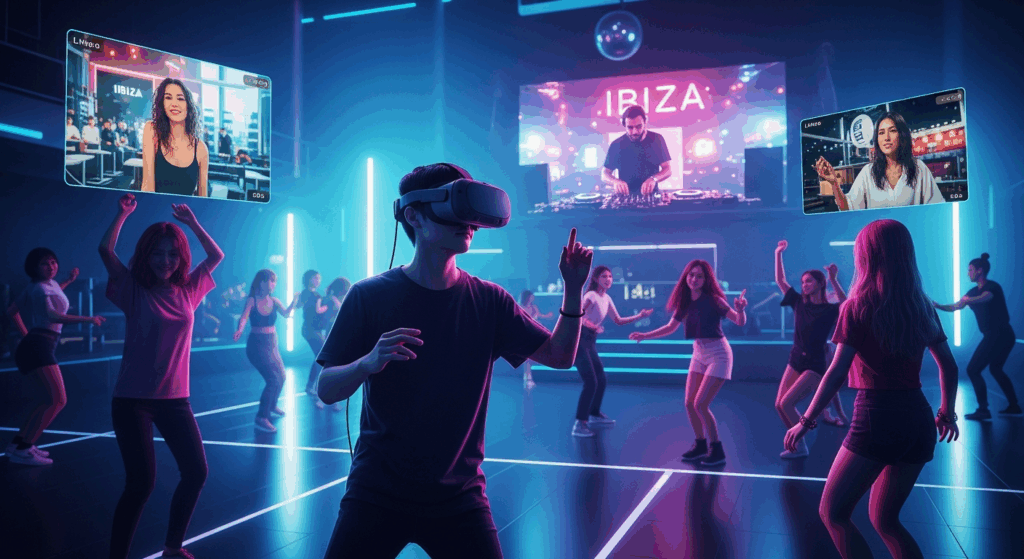
Additionally, for people who have trouble moving around due to physical issues or financial constraints, virtual clubbing offers real experiences that are just as enjoyable as being there in person. A person with disabilities living in a rural area no longer has to choose between their body and their passion for music. They can dance for 12 hours straight from their home in an avatar that represents exactly who they want to be that night.
The Technology: VR Headsets, Customized Avatars, and Haptic Feedback
The technological architecture behind these hybrid clubs is stunning in its simultaneous complexity and accessibility. VR headsets, once expensive and inaccessible, have experienced a 30% price reduction over the past five years. The Meta Quest 3S, a mid-range device, makes VR clubbing accessible to anyone investing less than 300 euros.
But the real value doesn’t lie in the headset itself: it lies in customized avatars and haptic feedback. An avatar is not merely a simple two-dimensional sprite: it’s a poly-articulated representation of the user’s body, with full-body movement tracking that captures every gesture, every step, and every head movement. The dancefloor becomes a digital mirror where your virtual corporality is indistinguishable from your desire to move.
Haptic feedback—the ability to feel vibrations synchronized with music—transforms the experience from visual to viscerally tactile. When a bassline drops, your virtual body receives the vibration. Rhythms are not just heard or seen: they are felt. Research on the effects of haptic feedback in rhythm dance games has shown that users experiencing haptic stimuli report 3.75 times deeper immersion compared to those receiving only visual input.
Monetization: NFT Passes, Virtual Memberships, and Digital Merchandise
The economic model of hybrid clubbing is still evolving, but clear paradigms are emerging. Virtual clubs monetize through three main channels: NFT passes, virtual memberships, and digital merchandise.
NFT passes function as “smart” tickets: they not only allow access to the club but also unlock exclusive benefits. A person owning an NFT pass for Vision Dubai receives VIP access to both the physical and virtual space, priority rights to the best spots, exclusive digital gadgets, and, in some cases, private virtual meetings with DJs. The price of these passes varies, but the principle remains the same: digital ownership creates verifiable exclusivity.
Virtual memberships operate on a subscription model. For 10–20 euros per month, a member can participate in all club events, collect digital badges, and build a reputation within the community. Amnesia Ibiza has experimented with this model successfully, creating a “seasoning” structure where regular virtual visitors become part of the club’s legend, just like physical visitors.
Digital merchandise—avatar wearables, exclusive backgrounds for personal virtual rooms, and avatar skins—represents an entirely new revenue stream that has no precedent in physical nightlife. A limited-edition t-shirt designed by Amnesia’s designers can be sold as an NFT to tens of thousands of global collectors, with profit margins enormously superior to those of physical merchandise.
Metaverse & Hybrid Nightlife: The Trade-offs of What We Gain and What We Lose
The transformation of clubbing toward the phygital model is not a pure upgrade: it involves significant trade-offs.
The advantages are evident: global accessibility without geographic limits, personalized experience at unprecedented levels, no mobility barriers, lower costs for the end user, and a potentially unlimited community. Furthermore, virtual clubbing eliminates risks associated with physical nightlife: no drunk transport effects, no robbery risk, and no exposure to sexist or violent behavior in the dancefloor dynamics.
The costs are real: the immersive sensory quality of collective dancing—the goosebumps that run through a crowd of thousands when the DJ drops the most anticipated beat of the night—cannot be completely replicated virtually. The Las Vegas Sphere brings us close, but the tactile feedback of thousands of physical bodies vibrating in the same moment remains inimitable.
Additionally, technological dependency creates vulnerability. A server crash or a latency issue can cause the party to end abruptly. In physical reality, the party continues. There’s also the risk of alienation: research on mental health suggests that prolonged exposure to virtual environments can create addiction and dissociation from physical reality, especially among younger people.
The digital divide continues to be a harsh reality in the context of the metaverse and hybrid nightlife. Despite the decrease in VR headset prices, they remain out of reach for billions globally. This situation raises concerns that virtual elite clubbing may inadvertently exacerbate exclusion for those unable to afford the necessary technology, leading to a “wealthy nightlife” that is digitally segregated. As the metaverse evolves, it is crucial to address these disparities to ensure that hybrid nightlife experiences are accessible to all, rather than creating a divide that mirrors existing socioeconomic inequalities.
Predictions for 2026: Simultaneous Hybrid Events on Global Scale
In 2026, the metaverse will dramatically reshape nightlife, giving rise to a wave of clubs that blend the physical and virtual worlds. Imagine this scenario: your favorite musician releases a new album on a Friday. The next Saturday, a club near you—whether in Berlin, Bangkok, or Buenos Aires—holds a pioneering event. The physical dancefloor and the virtual one, hosted on platforms like Decentraland and Roblox, are perfectly in sync. This seamless integration of the metaverse with nightlife allows revelers to experience both real and digital environments, fostering a vibrant community that transcends geographical boundaries.
The DJ performs once. The music reaches simultaneously the Berlin dancefloor and the virtual avatars of 50,000 people scattered around the world. AI-reactive visualization creates unique environments for each space, but the narrative sequence of the music remains identical. Physical and virtual people dance the same song, at the same moment, in an instant global community.
This process requires massive cloud computing infrastructure and ultra-low latency (facilitated by 5G rollout and 6G preparation). In 2026, these technical conditions will be close to implementation. In 2024, the global XR market reached a value of 92.5 billion dollars, and projections indicate that it will surpass 100 billion by 2026. With this level of investment, interoperability between different virtual worlds will become a technical and commercial reality.
Metaverse & Hybrid Nightlife: A New Era of Clubbing
The pivotal inquiry is not whether virtual clubbing will replace physical venues, but how these two realms will intertwine and redefine the nighttime entertainment landscape.
The answer? Neither dies; both evolve. Physical clubbing will never disappear because physical presence remains irreducibly valuable from an emotional and sensory perspective. However, physical clubbing will transform from a geographically isolated experience into a node in a global network of synchronized communities.
Amnesia Ibiza, in 2026, will no longer be merely a physical club with a virtual appendage. It will be a multidimensional entity where the reputation built physically over 40 years of history interweaves with a virtual community that can potentially be 10 times larger. Physical visitors will have access to exclusivity and authenticity that the virtual world cannot replicate. Virtual visitors will have access to a scale and cost that the physical world cannot offer.
Nightlife in 2026 will not be a binary system (online vs. offline) but a fluid continuum where clubbers will move fluidly between reality and virtuality depending on the needs of the night, personal budget, and emotional state of the moment.
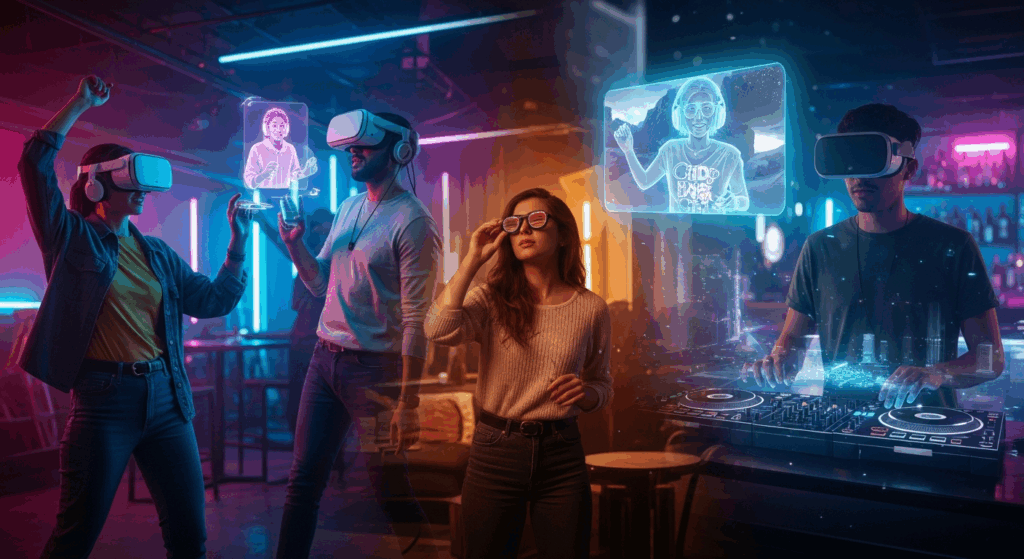
For the emerging generations of clubbers—Gen Z and Gen Alpha—metaverse & hybrid nightlife will not be a strange adaptation but the norm. Users will transition from the physical club app to the VR experience within minutes, perceiving both as integral aspects of one larger reality.
The transformation into the metaverse & hybrid nightlife has already begun.
The metaverse isn’t coming: it’s already here. This is not about the science-fiction forms imagined in the 1990s; rather, it focuses on the pragmatic, hybrid, and incredibly scalable forms that clubbing is pioneering. The next time you enter a physical club—in Ibiza, Berlin, or Milan—know that thousands of avatars are dancing in the same space, from Japan to Norway.
This is the future of partying in the realm of the metaverse & hybrid nightlife. Phygital, global, accessible, and infinitely stranger and more wonderful than we ever imagined.